Help
Short guides to everything Tabloto does today — by role, step by step. Nothing here is a promise about the future: it describes only what already works.
Tabloto is a tool for running a condominium. It is not accounting software and it is not a chat group. It does one thing: it turns a month in the building into clear bills that anyone can check.
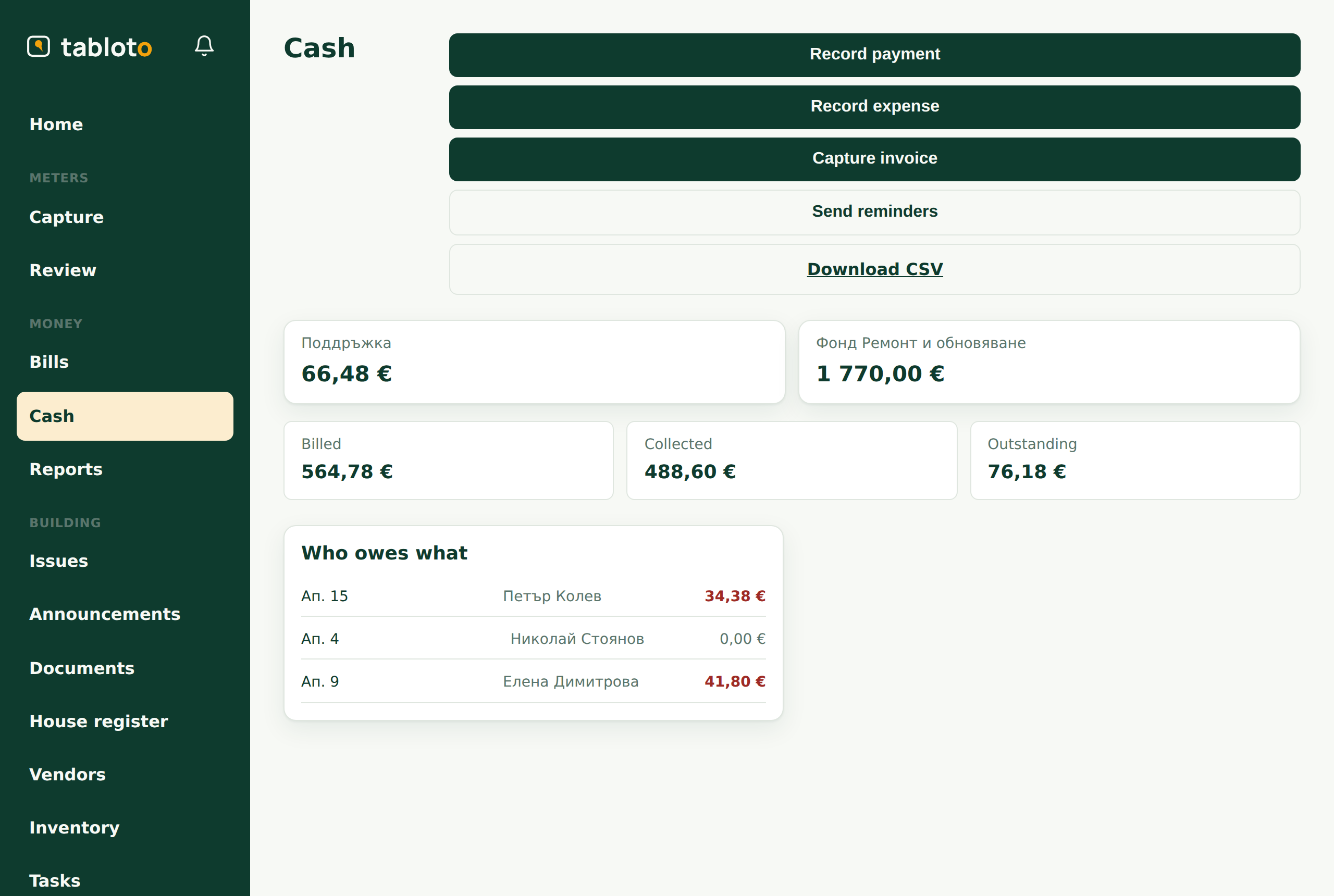
The month in the building
Everything in Tabloto turns around one loop, repeated every month:
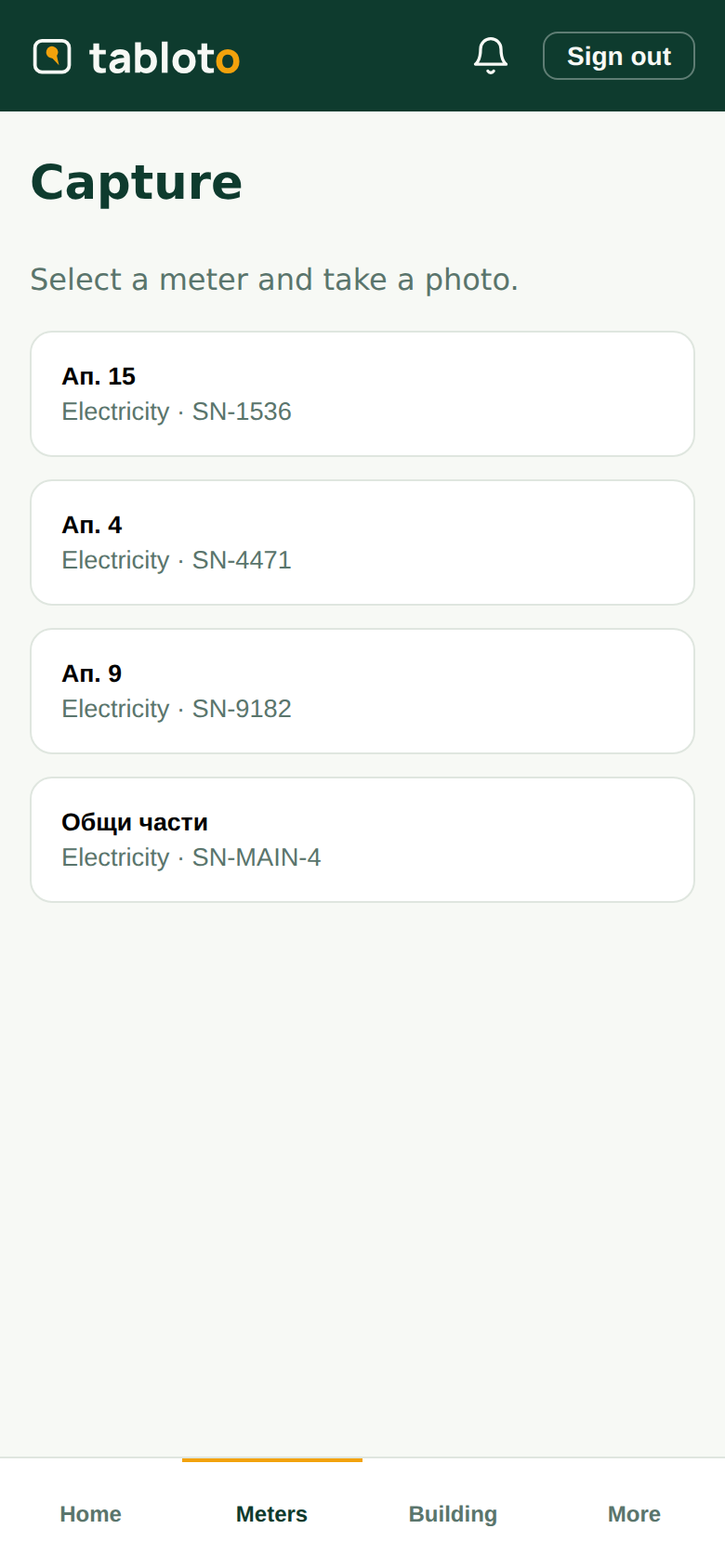
- 1 Photo The caretaker photographs the meters; the app reads the digits.
- 2 Reading The committee reviews — the doubtful ones come first.
- 3 Invoice The bill is split across the apartments, to the cent.
- 4 Payment The owner pays; late payers get a reminder.
- 5 Transparency Every movement goes into the ledger.
The caretaker photographs the meters with a phone; the app reads the digits off the photo. The committee reviews the readings — the doubtful ones come first, so a sharp jump is seen immediately, and a person confirms each one before it becomes anybody’s bill.
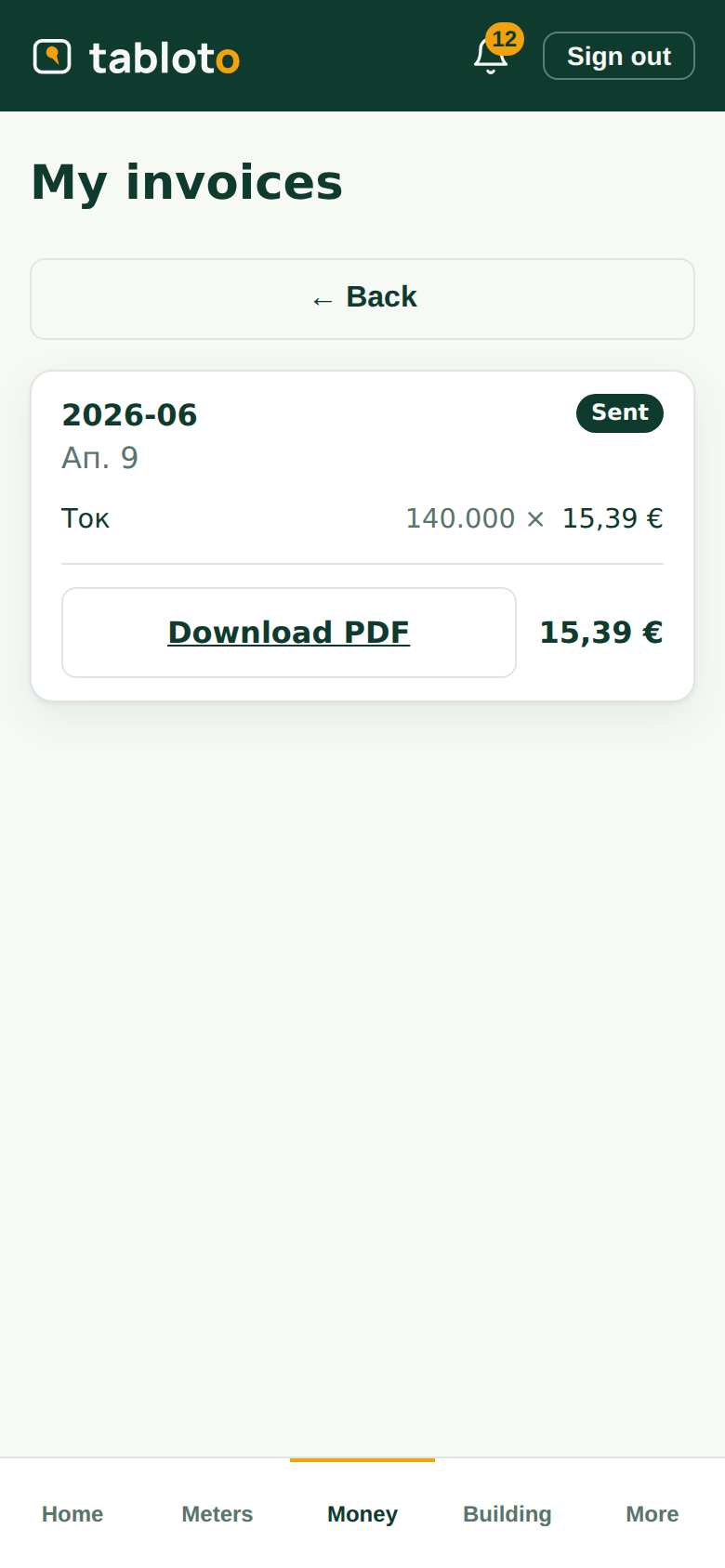
Then comes the invoice. You enter the supplier’s bill, press one button, and Tabloto splits the amount across the apartments — by ideal parts, by consumption, or equally, whichever the building decided. The total reconciles to the cent. The owner sees what they owe and pays; every movement goes into the ledger, and fund balances are derived from the movements, so they cannot drift apart from them.
That is all of it. The rest — issues, announcements, documents, polls, the register — sits around that loop.
Who sees what
Tabloto shows different people different things. Not because anything is hidden, but because your neighbour’s bill is not your business.
- The committee sees everything in the building and does nearly everything: bills, invoices, money, documents, meetings.
- The owner sees their own: their invoices, their apartment’s readings, the shared announcements and the polls. They do not see a neighbour’s bills — and the neighbour does not see theirs.
- The caretaker sees their work: the meters to read and the tasks assigned to them. They see no money at all.
- The control council sees the money — everything the committee sees, read-only. This is the elected auditor’s role under the Bulgarian condominium act: it checks, it does not run.
- The partner (an outside property manager) creates and configures the building, then hands it to the committee. They set up how the money is calculated, but never move it. Are you a partner? Start with How to demo Tabloto — the demo building is your ready-made sales instrument.
Pick your role below — the guides are ordered the way you will actually meet them.
Open the app Opens in a new tab.
Depending on who you are
Committee
You run the building: you enter the bills, issue the invoices, keep track of who has paid and what is in the funds, and answer to the general assembly. You see everything in the building — and nearly everything in Tabloto is done by you or through you.
- From an empty building to the first invoice The whole path, once: settings, units, meters, fees — and a first invoice issued properly.
- Onboarding with the .xlsx import The whole building at once from one spreadsheet — checked before anything is written.
- Readings and review How readings arrive, why the doubtful ones come first, and why a person always confirms them.
- Billing: from the supplier's bill to the sent invoice The period, the apportionment, the review, the approval — and why a sent invoice is never edited.
- Money: payments, arrears, reminders, funds Who paid, who owes, what is in the funds — and why the balances cannot drift.
- Expenses — by hand and from a photo How an expense is recorded, and how a photo of the supplier's invoice fills the fields for you.
- Polls Asking between assemblies: how to run one, who sees what, and why it is not an assembly decision.
Owner
You live in the building (or let it out): you see your own invoices and what you owe, your apartment's meter readings, the announcements, issues and polls. You do not see anyone else's bills — and no owner sees yours.
- My invoices and paying What you owe, where the amount comes from, and how to pay it.
- My apartment's readings Your meter's history, and the photo behind every number.
- Voting and issues How to say something: a broken light, an opinion on a question, and what happens next.
Caretaker
You do the work on site: you photograph the meters and mark how far you have got with the tasks the committee assigned you. Money is not your job — Tabloto shows you no invoices and no funds.
- Photographing a meter reading Walk the meters, take the photo, done. What to do when the digits do not come out.
- My tasks What the committee assigned you, and how to mark where you have got to.
Partner
You are an outside professional: you create the building, set it up, and hand it over to the committee. You configure how the money is calculated, but you never move it — the committee issues the invoices.
- How to demo Tabloto The demo building as a sales instrument: the accounts, the meeting script, and why nothing can break.
- Creating and configuring a building How to stand up a new building from nothing — and what to know before you start.
- The import and handing over to the committee A hundred apartments from one spreadsheet, and a clean handover to the people who will run it.