Money: payments, arrears, reminders, funds
Who paid, who owes, what is in the funds — and why the balances cannot drift.
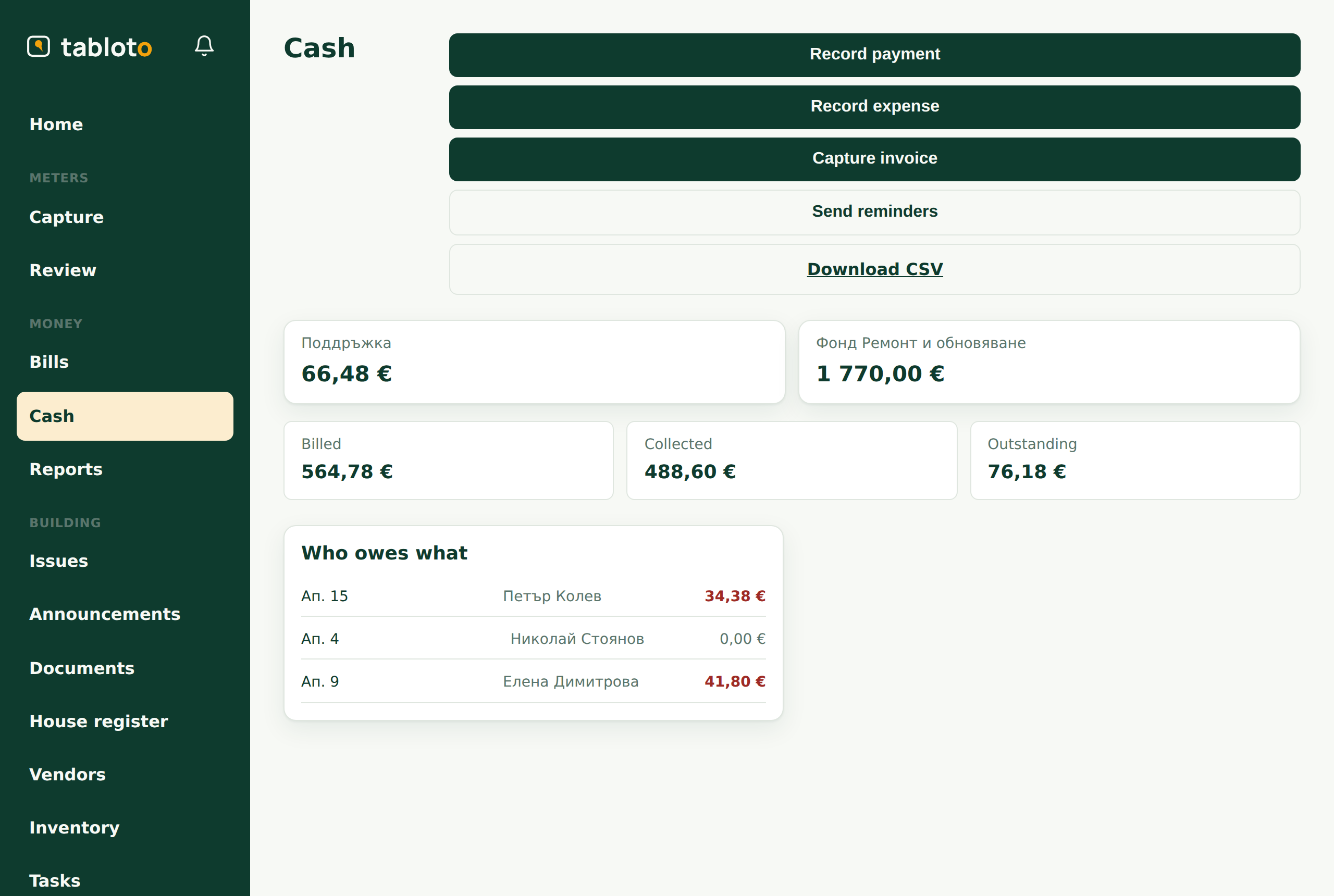
Money → Finance. This is where the building’s state lives.
Payments
When money arrives, you record the payment against the invoice: amount, date, method (bank transfer, cash, other) and a reference.
Tabloto allocates the amount across the funds the invoice charges, in proportion to its lines. If the invoice is fully covered, it becomes paid on its own. If it is partly paid, it stays sent, with an outstanding balance — you see how much is still owed.
If the building accepts cards, a card payment is recorded only when Stripe confirms the money moved. Not when the owner came back from the payment screen — those are two different things, and only the first one is money.
Arrears
Who owes what — a list by unit: invoiced, paid, outstanding.
The list shows the debtors. An apartment with nothing outstanding does not take up space.
Reminders
One button emails everyone with an unpaid invoice past its due date — and moves them to overdue. The email is in the recipient’s language. It can be run again; an invoice already paid is skipped.
Expenses
Every expense is recorded against a fund and comes out of it: lift maintenance, cleaning, repairs. An expense can be linked to an issue — then the issue shows what it cost.
How to enter one, including from a photo of the supplier’s invoice: Expenses.
Funds
A fund’s balance is not a field someone types. It is the sum of the movements: money in minus money out. So it cannot drift from the ledger — it is the ledger, added up.
The ledger is append-only. A row is never edited and never deleted. If something is wrong, a reversing row is added and stays visible. The money’s history is not rewritten — that is the difference between a report and a story.
Export
The ledger downloads as CSV — for an accountant, for the assembly, for checking in Excel.
The control council
If the building has an elected control council, it sees exactly this — funds, movements, arrears, invoices, the export — but read-only. Not to hinder it, but because that is its job under the condominium act: to check, not to run.